More Fallout from Bronsongate: The "Idiot" Checks in

Tuesday, March 21, 2006

Yesterday we discussed how the Red Sox, by trading Bronson Arroyo for Wily Mo Pena, may have broken a verbal no-trade promise to Arroyo after he--against the wishes of his agent--agreed to a below-market contract two months ago. Although the verbal promise (if there was indeed one) is not legally enforceable, one might wonder how this story will affect the trust placed by Red Sox players in team officials. But was there, in fact, a promise?

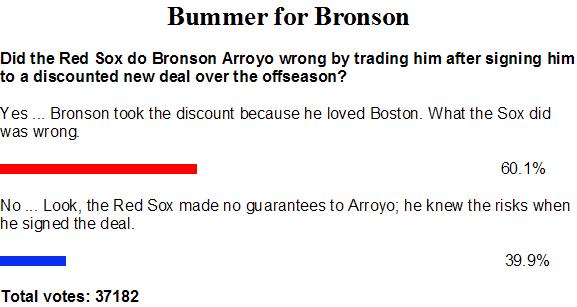
Well, Red Sox fans are certainly expressing their dismay as to how Arroyo was treated by Red Sox management. Take a look above at an unscientific poll on the Boston Globe's website: over 60% of fans believe "what the Sox did was wrong."

Earlier today, a clearly distraught/peturbed Arroyo conducted a Q/A with Gordon Edes of the Boston Globe:
What was it about Boston and the team that made you want to sign that contract?

“Just, you know, going to Fenway Park 81 times a year, man. There's an excitement in that place I'm not going to get anywhere in the National League except maybe Wrigley. So that was the No. 1 thing. And then, just the group of guys we've had that a lot of 'em still here, pitching to Varitek. I felt like Boston was my second home and I hadn’t felt that way about any other place I've ever played. So, you know, stuff kind of being uprooted. You feel like you're being ripped out of your home."

How did you find out you had been traded?

”Theo [Epstein] called me, as soon as I saw his name come up on my [cell phone] I figured he traded me. Yeah, definitely surprising. I always knew it was a possibility just because I'm a young guy who's got a pretty low salary, but I still didn't think he'd trade me, either.”

You said they made no guarantees that they wouldn't trade you, but what was the conversation?

“The conversation almost exact was ‘I'm not signing this deal to end up in Tampa Bay in two weeks.’ And they said to me, ‘There's no deal for you on the table right now and we don't foresee trading you in the near future.’ Those were the exact words. Near future is relevant to whatever you think. Obviously, there was no guarantee. But in my mind, this is pretty soon. But um, you know, they told me there was no guarantee, and I knew that. But I figured it would probably be further down the road if that happened, pitching bad around the All-Star break or whatever . . . I was surprised when Theo called me, I was really shocked."

Is there a part of you that wants to say, “how could you?”

“Uh, yeah, a little bit. Of course, man.”

Have you talked to Red manager Jerry Narron or GM Wayne Krivsky?

“No I talked to three other people. I don't even know who they were. I couldn't listen, you know, my brain was scrambled yesterday after Theo told me that. I talked to a few other people, some of the clubhouse guys. That was it.”

How long will it take for the trade to sink in?

“Probably when I turn on the TV and see the Red Sox playing, you know, and I'll be playing someplace else. You know, it's tough, man, but what are you going to do. All you can do is go pitch. I got three years until I'm a free agent so I'm going to pitch and see where you end up.”
So, in other words, there was no promise, explicit or implicit. Nevertheless, former Red Sox outfielder Johnny Damon (the self-described "idiot" who signed with the New York Yankees this off-season), believes the Sox have wronged Arroyo:
"I'm really upset for Bronson. He should be able to become a free agent after this year, re-do his contract. This is what they were afraid of - his agent was right."
While criticizing Red Sox management for lack of loyalty, Damon cited his own failed negotiations with the team. Incredulously, he also alleges that, in 2004, he bought a house in Boston that the 4-year, $32 million he signed with the Red Sox in 2001 couldn't support:
"I bought a house that I could not afford at the time, in Boston because they said, `We're going to keep you, we'll get something done real soon.' This was right after we won the World Series [in 2004]. Obviously, that never happened. After they didn't come to me during the [2005] season, my loyalty to them wasn't there anymore either. I felt the loyalty from them was gone."
Lastly, Damon criticizes the Red Sox for their use of computers and technology in making personnel decisions:
"They have their plans, and they have their computers, and they believe that's right. Unfortunately, computers don't judge a person's heart. Getting along with the younger kids and helping them along, unfortunately, computers don't [evaluate] that."
Clearly, somebody needs to introduce Johnny Damon to the writings of Ray Kurzweil.

I Don't Want to Play Left Field

Great story last night about how Alfonso Soriano of the Washington Nationals refused to play left field in an exhibition game. Check out the story on espn.com here.

Soriano, a second baseman, was traded in the off-season from the Texas Rangers to the Nationals for OF Brad Wilkerson and two other players. One problem - the Nationals already have an all-star second baseman in Jose Vidro.

No problem, Washington thought, we'll just move Soriano to the outfield.

Another problem - Soriano doesn't want to play the outfield and said so from the get-go.

Well, Soriano returned to the Nationals yesterday (he had been playing with the DR in the WBC). Manager Frank Robinson had Soriano batting leadoff and playing left field. However, with the game about to start, left field was vacant. That's right - Vacant! Soriano just decided not to take the field at all. Eventually, Robinson came out and made a switch, but fans and players were very confused.

I do have to admire Soriano for sticking to his principles. He said he was not going to play outfield, and he obviously didn't change his mind. However, you would think the situation could have been handled a little more maturely.

In my opinion, though, the real people at fault here are the Nationals' management. You would think that a team would find out if an all-star was willing to make a position switch before they traded for him. Now, they are probably going to have to trade for him for 30 cents on the dollar.

Washington GM Jim Bowden says that the refusal to take the field was a violation of Soriano's contract (he's probably right), and is threatening to report him to the commissioner for placement on the disqualified list (which would, in effect, suspend his service time). However, that doesn't change the fact that the guy made a stupid trade without doing all the necessary research.

The Downside of Gender Equality

Monday, March 20, 2006

The Sixth Circuit heard arguments last week in a case from Michigan, where the plaintiffs are arguing that the Michigan High School Athletic Association violates federal antidiscrimination statutes, namely Title IX, by scheduling female sports in different seasons from male sports. (Story) The harm claimed is that playing in off seasons affects girls chances to get athletic scholarships. Back in 2001, the federal district court held for the plaintiffs and the case has been in appeal ever since. The latest argument, on remand from the Supreme Court, is on a procedural point that is not likely to end the case.

The question I have, however, is not related to whether the practice is discriminatory. Even if it is (under a strict reading of Title IX), do female athletes suffer more by having to play at the same time of their male counterparts? Last month, the Washington Post featured an interesting article on just this topic. (Watts, "Title IX Ruling Makes Girls' Sports a Tough Draw," Wash. Post, 02/21/06).

In 2000, a federal district court in Virginia faced the identical question and came to the same conclusion, ordering that female teams play in the same season as male teams. The result, however, has not been all positive. Now that they are competing with boys teams, many girls teams have experienced a sharp drop-off in attendance since the schedule change.
    By tip-off of the Feb. 3 [girls] game, fewer than a hundred fans filled the Loudoun County bleachers. And aside from both teams' junior varsity players, fewer than 20 people in the gym appeared to be of high-school age.

    But just 2.3 miles down the road at Heritage, where the Pride boys were hosting Loudoun County on their Senior Night, nearly 800 fans filled those bleachers, an estimated 70 percent of them students from the two schools.

    "I remember my freshman year there were tons of kids at the games and afterward they'd all be on the court celebrating with us or whatever," said Broad Run senior Whitney Vlasic, a four-year varsity basketball player. "Now it's all parents in the stands."
There are also problems with locker rooms and practice times, especially for schools that have just one court. Teams must practice very early before school or very late after school; many games are now played at odd times, or even at other schools' gyms, to accommodate all of the teams.

So, does this help girls athletics more than it hurts it? I haven't seen the data on athletic scholarships (or other potential harms), but I find it hard to believe it is that great. After all, college teams want the best athletes, no matter when they play. And, considering the fact that the overwhelming majority (at least 99 percent) of high school athletes don't receive athletic scholarships, is the burden so widespread to make it a problem? On the other hand, if girls basketball was played in a different season than boys, both squads could share top-notch gyms, practice facilities and gyms. Students could come support both teams, rather than being forced to pick one over another. In other words, there would be little discrepancy between male and female teams. Isn't that what Title IX is all about?

Broken Promise? Red Sox Trade Bronson Arroyo

On January 19, 2006, 29-year old pitcher Bronson Arroyo took a "hometown discount" by agreeing to a three-year, $11.2 million contract with the Boston Red Sox and avoiding arbitration with the team. He did so against the wishes of his agent, Gregg Clifton, who felt that his client left over $4 million on the table.
"I signed the deal at a pretty good discount . . . Fenway Park is a joy to come to every single day. I love playing here. I love the fans. I love the city. I want to stay here for my whole career, I feel that's going to beneficial for me as well as the team. Hopefully, they see it that way and don't trade me. [Then co-general managers] Jed [Hoyer] and Ben [Cherington] both stated to me that there was no deal on the table for me right now, and they felt pretty strongly that I wouldn't be traded any time anywhere in the near future. They couldn't guarantee me security for the lifetime of the contract."
Today--a mere two months and a day from when Arroyo signed the contract--the Red Sox traded Arroyo to the Cincinnati Reds for outfielder Wily Mo Pena. Perhaps unwittingly, by agreeing to a below-market contract, Arroyo likely aided the Red Sox in dealing him to a smaller-market team like the Reds. Nevertheless, Arroyo might be understandably annoyed at Hoyer and Cherrington if they indeed intimated that, in exchange for signing a below-market deal, he likely wouldn't be traded in the near future. Then again, Theo Epstein is now calling the shots again, so perhaps an oral promise by Hoyer and Cherrington was conditional upon them remaining in charge. In any event, expect Red Sox players to think very carefully about oral promises by Red Sox management from here on out. The same might be said of free agents when considering whether to sign with the Sox.

One-Time Transfer Exception

NCAA By-law 14.5.5.2.10 is known as the One-Time Transfer Exception. This by-law permits a student-athlete at a four-year college or university to transfer to another four-year college or university without being required to sit out a year in his or her sport.

There are certain requirements for this exception to apply. Specifically, the exception can only be used once for an athlete, the athlete must be in good academic standing and meet certain progress towards degree requirements, and the institution from which the athlete is transferring must state in writing that it has no objection to the waiver (often referred to as a "release").

In addition, the student-athlete may not be a participant in basketball (men's or women's), men's ice hockey or Division I-A football at the institution to which the student-athlete is transferring. In other words, the exception does not apply for football, basketball and men's hockey players. These student-athletes are generally required to sit out a year. The reason for this is that participants in these sports traditionally do not do as well academically as other student-athletes, as measured by graduation rates. There have been recent proposals to extend the transfer exception to these sports, but they always seem to get shot down.

Another proposal has been brought up recently to eliminate the exception for baseball student-athletes. This proposal has evidently been through the management council twice, being opposed both times, but will be looked at again in April. I spoke to an NCAA representative today, who believes the chance of this proposal passing is unlikely. The proposal keeps popping up, though, because there is a higher transfer rate in baseball than in most other sports, and many in the baseball community believe the ease of movement in baseball contributes to a lack of academic success.

I am interested to hear (1) whether anyone has heard anything else about the exception being eliminated for baseball, and (2) whether people believe it should be eliminated in baseball, or other sports for that matter.

If the baseball proposal goes into effect, the effective date would not likely be until at least August 1, 2006, so I would expect an increased amount of transfers this summer (assuming that the athletes can get their coaches to give them their releases).

The NFL's "Poison Pill"

Many lawyers are familiar with a "poison pill" in corporate law, which are defensive measures intended to prevent hostile takeovers through stock acquisition. (More) Now, the NFL has its own measure of the poison pill and an arbiter will decide on Monday how integral it is to a player contract. (Story). Steve Hutchinson of the Seattle Seahawks, widely considered to be one of the best guards in the league, signed a 7-year $49 million dollar contract with the Minnesota Vikings last weekend. The Seahawks have the right to match the deal, and want to do so, but the Vikings have included a "poison pill" clause.
    [The clause] stipulates that Hutchinson must be the highest paid offensive lineman on his team after the first year of the contract and that, if he isn't, the entire contract becomes guaranteed. The provision is a difficult one for the Seahawks, who have the right to match the Minnesota offer, because offensive tackle Walter Jones is the team's highest paid lineman and would be even if Hutchinson were on the Seattle roster.

    Less than 2 percent of NFL contracts are fully guaranteed and those are usually limited to quarterbacks or other players at skill positions. Having to guarantee Hutchinson's contract would break new ground.
The Vikings clearly took a risk with Hutchinson's contract, but did so because they knew that Seattle would not be able to match the offer without making an enormous financial sacrifice. Now, the Seahawks are asking the arbiter to declare that the pill is not a principal term of the deal, and thus, they should be able to match the financial terms of the contract without adopting the pill.

My guess is that this is not a winning argument, but it will be interesting to see how the arbiter (Professor Stephen Burbank) views it. Is the clause solely a defensive measure, and thus, something for which Hutchinson has given no consideration? Or is it part of his compensation package? He does not stand to make more money; the clause is more likely to prevent action on the part of the Vikings. But having his contract be guaranteed would be a huge gain.

UPDATE (3/21): Seahawks lose; Hutchinson is now a Viking.

Book Review: Fantasyland by Sam Walker

Sunday, March 19, 2006

As a devoted player of fantasy sports, I was excited to pick up a copy of Fantasyland by the Wall Street Journal's Sam Walker. I finally got around to reading it and the book did not disappoint. In 2004, Walker did what millions of fantasy players can only dream of -- he made managing a fantasy baseball team his full-time job. And he did so with a team in Tout Wars, the private Rotisserie League played by the experts of fantasy baseball. Spending over $50,000, which included travel to watch games and hiring two employees, and exhausting the patience of both his wife and dog, Walker lives and breathes fantasy baseball for the entire season.

Whether you are a baseball aficionado, the manager of three fantasy teams, or just a fan of sports in general, it is impossible not to get sucked into Walker's description of his quest. I laughed at his rookie mistakes, including a costly mistake at the draft and knee-jerk trades, comparing them to similar blunders I have made throughout my fantasy "career." It is hard to put this book down, as Walker weaves stories about his team in with meaningful insights about the battle being waged in baseball between old-school "purists," that rely on gut reactions and insider knowledge, and the new generation of economics-driven baseball executives, for whom statistics and hard data are the only way to objectively evaluate performance. Walker even personifies these two camps through his employees: Sig, the master of Excel spreadsheets and Zoladex, a program he creates to determine optimum player value, and Nando, whose Hunchmaster system combines accepted metrics such as scouts' opinions with unconventional data ranging from a player's marital status to religion and arrest records. Walker is careful not to pick one side over the other; he balances the power of numbers with his own feel for the intangibles in making the final decisions on player selection and trades.

Despite the undercurrent of the baseball debate, the book's central message is the impact of fantasy sports on the real sports around which they revolve. Walker's job as a baseball writer gives him unique access to players and executives. As he interviews these baseball insiders and admits to them the purpose of his questions (i.e., helping his Rotisserie team), some scoff and castigate Walker for elevating a parlor game over their livelihood. Others, however, embrace the "fake" game that have heightened the interest of so many fans in the "real" game.

These players and executives seem to understand that in a world of ever-increasing entertainment options, anything that keeps fans interested is good for the game. Walker's devotion to his team -- staying up until 1 am to watch a Blue Jays-Devil Rays game, making repeated trips to the ballpark to see his players in action, and keeping a constant vigil at news and statistics websites -- is not uncommon in the fantasy sports world. Walker sums it up best when describing a slump by his "team": "I haven't cared this much about sports -- or been this despondent about a setback -- since the fourth grade, when Michigan blew the 1979 Rose Bowl. (I locked myself in the bathroom.)" This is the same logic that leads the NCAA to look the other way, if not downright encourage, participation in bracket pools during March Madness. Anything, even if not "real," that keeps people as interested in sports as they were when they were young and had no other worry in the world, is undeniably great for the game.

In the end, Walker learns what many fantasy players already know: that it is often luck as much as skill that determines the ultimate winner of a fantasy-sports league. This makes fantasy sports much like the real-life counterparts on which they are based, and it serves as a reminder that winning or losing, while perhaps the goal, is not the only barometer of a successful season. After all, as with all sports, it's often not the outcome that matters, but rather how much fun you have playing the game.