Justice Scalia to Speak at Mississippi College School of Law Today

Tuesday, April 4, 2006

It's an exciting time for my law school, as Associate Justice Antonin Scalia of the United States Supreme Court will be speaking to faculty, students, and guests later this morning here in Jackson, Mississippi. We will then host a luncheon for him, and later on in the day he will be judging the Mississippi Moot Court Championship, which will be held at my school and will feature our student moot court teams competing against teams from the University of Mississippi School of Law. Other judges for today's Championship will include Chief Judge Deanell Reece Tacha of the U.S. Court of Appeals for the 10th Circuit, Judge E. Grady Jolly of the U.S. Court of Appeals for the 5th Circuit, Judge Charles Pickering formerly of the U.S. Court of Appeals for the 5th Circuit, and Judge David Bramlette of the U.S. District Court for the Southern District of Mississippi. With that spectacular group, I am sure our moot court students will be asked some excellent questions.

But going back to Justice Scalia and his talk to the law school, he will entertain questions. I imagine some questions might pertain to national security law or to religious freedom or to other timely topics. But what about sports law? What might be good questions to ask him about our favorite legal topic? (other than obvious ones, like, "Justice Scalia, why was Clarett v. National Football League so wrongly decided?"). After-all, Justice Scalia wrote a memorable and humerous dissent in PGA Tour, Inc. v. Casey Martin, so we know that he has an interest in sports law.

And if you could ask Justice Scalia one question about sports law, what would it be?

Nospace: Is MySpace Inappropriate for Student Athlete Expression?

Monday, April 3, 2006

In recent months, a hot topic of discussion on college campuses has been the regulation of personal web pages, specifically linked pages through networks like MySpace and Facebook, spurned on by a well-written article by Erik Brady and Daniel Libit in USA Today (Brady & Libit, "Alarms Sound Over Athletes' Facebook Time," USA Today, Mar. 8, 2006). Such websites may require an invitation from the individual website host to view, while others simply require an “.edu” email address to generally search.

While schools do not sponsor such sites, administrators have in some cases disciplined underage students for drinking in photographs posted to such personal sites. Punishment has been handed down for disparaging remarks made about other students and staff members on such sites. Most schools have also made clear that a primary motivation for regulation of such sites is student safety due to the personal information disclosed by individuals on their respective sites, including, phone numbers, addresses, and birth dates. While personal safety is a concern, references have been made to protecting athletes from exploitation by agents and gamblers, as well.

Interestingly, student athletes seem to be under particular scrutiny by universities to remove material from their pages on MySpace and Facebook.

Most recently, John Planek, the Athletic Director at Loyola University (Chicago) banned all athletes from even having profiles on such sites, regardless of the content of said sites. According to Planek, Loyola will enforce this rule, "[the] same way we enforce all the other policies. [If] you don't follow the rules, you aren't on the team. It is a privilege to participate on our teams, not a right...Some rules [athletes must follow] are [a] part of the NCAA, others we instituted...The world a student athlete lives in gives them a certain number of privileges. [However], they have to adhere to certain rules and regulations."

This writer is not aware of any other college taking such a strong stance on such sites, but other student athletes have been punished for certain content on their sites, or simply advised to edit the content. Some examples:

- Baylor, Kentucky, George Washington, and Florida State have warned their athletes to responsibly post.

- Eddie Kenney and Matt Coenen were kicked off the LSU swim team after school officials discovered the two were members of a Facebook group that published insulting comments about their swim coaches.

- Colorado offensive tackle Clint O'Neal and his girlfriend, cross country runner Jackie Zeigle were ticketed for harassment for allegedly sending a racially threatening Facebook message to Hispanic cross country runner Greg Castro in December 2005. O'Neal was also suspended from the Champs Sports Bowl.

Brady and Libit’s article quotes Kermit L. Hall, president of the University at Albany (N.Y.), as believing schools to be legally justified in regulating student athlete use of such sites, but not necessarily the general student population.
"Students who join those teams submit to a certain degree of regulation that doesn't follow the rest of the student population. There are team rules on curfews and other things, and if one of those rules is you can't be on Facebook — or, if you are, that you present yourself in a way that shows the values of your university — I think schools can do it.”

"Facebook presents a vivid reminder of the paradoxical world in which athletes on campus have to function. They're not public figures in the sense of New York Times v. Sullivan, but they are public figures in the sense that they appear regularly on the sports pages."
Is it possible to make a distinction between athletes that doe not “appear regularly on the sports pages” versus participants in revenue sports like football and basketball? Is there a distinction here between the regulations that could be undertaken by a private versus a public institution? In speaking with some high school and college students, membership in networks like MySpace and Facebook are “essential” elements in their social lives. Could severe restrictions like Loyola’s and severe actions like those undertaken by LSU hurt recruiting of student athletes?

The Grass Was Always Greener: Red Sox Make Progress in Attempt to Sign Roger Clemens

A good example of how a team can distort contract negotiations with a free agent player at the expense of a competing team, and doing so right on the competitor's own turf makes it seem even sweeter:
According to Sports Radio WEEI in Boston, Roger Clemens had dinner with Red Sox GM Theo Epstein and interim pitching coach Al Nipper on Sunday night [in Arlington, Texas, where the Sox will begin the season] and met members of the team on Monday.

We're guessing this wasn't what Rangers owner Tom Hicks had in mind when he invited Clemens to Opening Day. The Red Sox have taken advantage and used the time to try to lure the 43-year-old back to Boston, with David Ortiz, Tim Wakefield and Josh Beckett among those talking to him today. Clemens isn't expected to decide on his future for at least another month.
The Red Sox also provided Clemens with a video of his good times in Boston. Clemens apparently told Chris Snow of the Boston Globe: "my two youngest kids cried when they saw the video, and my family is really warming to the idea of pitching again in Boston."

I've always found it interesting when teams try to manipulate the situational factors that affect free agent players' presumed preferences, and when they try to exploit the cognitive biases that afflict players and all of us in our thinking. Along those lines, I assume that Theo Epstein and gang didn't reminisce about everything from Clemens' previous stay in Boston.

A Market Solution to Baseball’s “Asterisk” Problem

Sunday, April 2, 2006

As the MLB season opens today, one of the league’s hyped stories is Philadelphia shortstop Jimmy Rollins’ hitting streak. Rollins hit in the last 36 games of the 2005 season; his streak is now the ninth longest in baseball history; with 21 more games-with-hits he will break the one record in baseball that no one thought would be broken: Joe D’s 56-game hitting streak. Oh wait, no he won’t. According to MLB, “If he succeeds, Rollins will be recognized as the holder of the longest hitting streak in Major League history, though DiMaggio will keep the single-season mark.” In other words, Rollins will have a record, but one with an asterisk – much like the asterisk (formerly) on Roger Maris’s single-season homerun record. The Rollins asterisk makes some sense; hits in games at the end of a season (in which teams may be out of contention, or resting players in advance of playoff runs, and thus not deploy their best pitchers and fielders) are not the same as hits in July. Depending on how baseball’s investigation of Barry Bonds ends up, if Bonds breaks the lifetime homerun mark he may have his record *’d as well (* = Bonds was possibly juiced up while hitting a good number of these homers).

I understand baseball’s recent fascination with record-breaking performances. After all, the memorable McGwire-Sosa contest was one of the most important factors in curing baseball of its post-strike blues. Pitching Rollins’s possible “record breaking*” season is an obvious PR ploy aimed at distracting the public from the ongoing steroid investigation.

Instead of adding *’s after records, some of which are defensible while others are not, MLB should get out of the business of assigning “official” record-holder status to any of its current or former players, and ignore that records exist or are broken. Instead, MLB should let the market decide which are the “definitive” records and who holds them. Various private companies, with a profit motive, can offer their own “definitive” records for public and media consumption. Guinness can get in the game; so can U.S. News and World Report. Bonds may break the career home-run record; but if the public “rejects” that record as definitive (or rejects Rollins’ multi-season streak as being a streak at all) by way of choices made by the market, MLB won't need to slap Bonds with a *.

Empirical Study on how NCAA and Member Schools Profit from Basketball Players

In second part his front-page examination of the NCAA for the Indianapolis Star, Mark Alesia studies the extent to which schools and the NCAA profit from star players (Alesia, "Tourney Money Fuels Pay-to-Play Debate," Indianapolis Star, 4/1/2006). Strikingly, according to Alesia, fewer than 1% of NCAA athletes generate more than 90% of the NCAA's money, which confirms the incredible economic value of hoop stars to colleges and universities. Alesia uses additional ways to expose the popular refrain, "these kids shouldn't complain, they are getting a free education," as profoundly unfair. For instance, he mentions how Scott Pollard, while a student-athlete at the University of Kansas, struggled with finances as he watched Kansas sell his replica jersey to fans. Alesia then reveals this nugget:
43 of the 50 public-school teams in last year's tournament generated a combined $267 million for their athletic departments, mostly in ticket sales, donations and TV revenue. Those schools gave out a total of $12 million in men's basketball scholarships. The rest was used to pay for coaches, administrators and money-losing sports -- basically, all others except football.
Pretty good deal for the schools with top basketball programs: they pay out a combined $12 million for the athletes who generate $267 million for them. Alesia interviews Ellen Staurowksy, a professor of sport management at Ithaca College, who contends, "the hidden part of the budget (in big-time college sports) is the artificial suppressing of the value of the people making this run." As a result, some argue that NCAA players should be provided with some kind of stipend. Pistons guard Chauncey Billups agrees:
"I've had the conversation with a couple of my teammates about this issue. Tayshaun (Prince) went to Kentucky and Rasheed (Wallace) went to North Carolina and Rip (Richard Hamilton) went to UConn. Those places make millions of dollars (in basketball revenue). You're telling me it's not fair to pay those kids a stipend? I'm not saying to pay them NBA money or $200,000 or $300,000. I'm not saying that. But at least a little stipend would be fair, without a doubt."
Duke senior J.J. Reddick, however, believes that the simplicity of the current system -- where players get nothing and the schools get everything -- justifies it (sort of like how people justify the flat tax idea on grounds that it's simple, without considering its fairness or desirability):
"I really don't think that college athletes should be paid a stipend. Should one player get more than another? Should a guy at a big school whose jersey sells for Nike be paid more than (someone) at a low D-I school? Doesn't make sense. I think the easiest way is to just have the system that's in place right now."
Possibly the most interesting part of Alesia's study pertains to research from Robert Brown, an economics professor at Cal State-San Marcos, who studies the value of college athletes. Brown's research shows that a basketball player who goes on to be drafted by the NBA is worth $900,000 to $1.2 million to his athletic department per year while he’s in college. Check out this chart, which, through assorted metrics, calculates the value of individual players in last year's NCAA Tournament championship game. Raymond Felton, for instance, generated $1.2 million for UNC, while Deron Williams brought in $970,000 for Illinois. The lowest value player on either team, Illinois' Shuan Pruitt, generated about $70,000 in revenue--or about 7 times the value of one-year of his 4-year scholarship. Gotta love simplicity in action!

A truly outstanding work by Mark Alesia, and congrats to the Indianapolis Star for publishing it. Related links:

Part I of Study: College Pays, Public Pays (3/30/2006)
Part II of Study: Tourney Money Fuels Pay-to-Play Debate (4/1/2006)
Interactive Database: NCAA Financial Reports (3/30/2006)
Chart: How Much Would College Players Be Worth? (4/1/2006)
Sports Law Blog: New Study on College Sports Finances and NCAA Tax Exemption (3/31/2006)
Sports Filter: Discussion of Alesia Study (3/31/2006)

Should Sports Teams be Owned by Public Corporations?

Saturday, April 1, 2006

Rumors continue to circulate that the Tribune Company, a publically owned diversified media company, plans to sell the venerable and perpetually unsuccessful Chicago Cubs. Chicago Tribune columnist Rick Morrissey joins the plea yesterday: “Sell them to Mavericks owner Mark Cuban or Aon Executive Chairman Patrick Ryan. Sell them to somebody. Just sell them.” For years, Chicagoans have speculated that the rational-thinking corporate executives at Tribune have concluded that a less successful franchise is actually profit maximizing. These executives, constrained by fiduciary duties and the shareholder primacy norm, focus on that bottom line and not on producing a winning team. Morrissey’s call to sell the team to an individual, rather than another corporation, reflects the belief that an individual owner might spend irrationally in a way that finally leads the Cubs to win. In many ways, though, it is also a rejection of the capitalist system and Adam Smith’s invisible hand.

It’s possible that irrational spending on sports franchises is actually socially optimal, if those franchises have what economists call “positive externalities” on the city or community that are not captured in the simple decision of how much to spend to produce a certain level and quality of sports. But if there really is such a market failure, a better way to correct it would be via regulation or public intervention (rather than placing restrictions on who can own a team based on speculation about who might spend in a socially optimal manner). If in fact having the Cubs win would offer benefits to the city of Chicago that are not enjoyed by the team’s corporate owner, perhaps the team should be “nationalized” via eminent domain. As many readers recall, the City of Oakland attempted to exercise eminent domain over the Raiders to keep them in the city; that effort was initially well received in the courts but subsequently rejected on dormant commerce grounds.

David Ortiz: Overpaid or Rewarded?

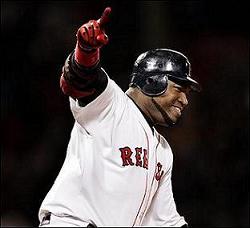
I'll admit it: David Ortiz is my favorite Red Sox player since I started following the team in the early 80s. He's the most clutch hitter I've ever seen and sitting in Fenway Park and watching his swing is alone worth the steep price of admission. He's one of those players who today's Red Sox fans will tell their grandkids about, and they'll describe him as a majestic, almost super-human presence. Perhaps not surprisingly, he's also incredibly likeable, adroitly handles media and fan requests, and does a lot of charity work. In fact, I don't think you could find a single person who would say something bad about David Ortiz, the runner up for the 2005 AL MVP award. He only further endeared himself to Red Sox fans by taking a steep hometown discount in 2004 when signing a 2-year contract worth $12.5 million, with a team option for the 2007 season at $7.7 million.

So I was naturally pleased to read that the Red Sox are about to sign him to a four-year contract extension worth $50 million. He could have become a free agent at the end of the 2007 season, but now "Big Papi" will likely remain with the Sox for the rest of the decade.

Not all Red Sox fans are happy, though. Some of the baseball guys on the Sons of Sam Horn message board (whose membership includes Sox owner John Henry and pitcher Curt Schilling) believe that the contract will prove to be a financial albatross for the team, and they employ myriad statistical devices to evidence that assertion. The idea is that Ortiz, who is 30 years old, will decline in production over the course of the contract, and that the 2007-2010 version of David Ortiz will be vastly inferior to the outstanding 2003-2005 version. For instance, a poster named "Fratboy" studied Ortiz's "Marginal Value Over Replacement Player" and concluded, "he'll be wildly overpaid in 2008, 2009, and 2010, and these are the weighted mean projections! Any regression that occurs would be detrimental. You shouldn't be paying $13 million for a $4 million player."

Let's say these gloomy projections are correct and that the great Ortiz indeed devolves into a pedestrian hitter towards the end of his contract. Here's my reaction: Who cares? Ortiz has been profoundly underpaid over the last three seasons, so overpaying him now can be seen as a contractual balancing to a most deserving franchise player and one who exudes all of the spirit and passion expected of a future legend. And plus, think of the message it sends to younger Sox players, who might later approach the bridge that could lead them out-of-town for more money: if you're good to us now by taking a hometown discount, we'll be good to you later by overpaying you then. Granted, that's a "risk" that some players may later regret taking, as they may perform worse than expected after taking a hometown discount, but the point is that by overpaying Ortiz, the Sox can more credibly make that promise.

Plus, now the Sox and Ortiz avoid the inevitable distraction that arises when a franchise player starts to publicly discuss free agency, as well as the acrimony that often emerges when that player becomes a free agent. And although no number or statistical equation will confirm this, distraction and acrimony are real costs inflicted upon a franchise, its players, and its fan base. Red Sox fans know that all too well from the team's prolonged, embittered, and ultimately failed efforts to re-sign Nomar Garciaparra, who was eventually traded to the Cubs, or Pedro Martinez, who signed with the Mets (subjects that I address in a forthcoming article in the Brooklyn Law Review).

But more conceptually, should new contracts only reflect future performance, or should they also reflect past performance? In other words, what are we actually paying these guys for, the past or the future or both? And what is loyalty really worth, and what does the absence of loyalty really cost?